
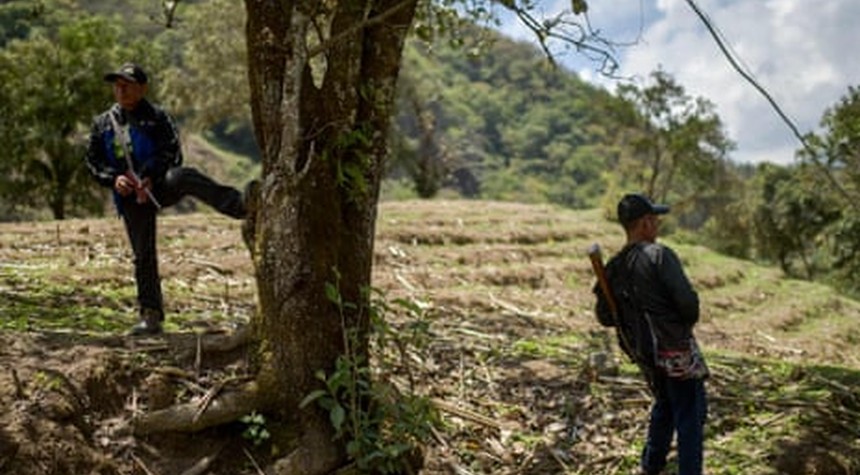
The mountains of central Mexico have become the latest battleground in the nation’s ongoing struggle with organized crime, as hundreds of Indigenous families flee their ancestral homes under sustained attack from a criminal organization employing military-grade weaponry.
The National Indigenous Congress reported Monday that between 800 and 1,000 families have been displaced from their villages in Guerrero state following intensified attacks by Los Ardillos, a criminal gang that has operated in the region for years. The violence reached a critical threshold last week when villages endured eight continuous hours of drone bombardment on Saturday.
“There is total anguish among the people,” stated Carlos González García, a spokesperson for the congress. “The families are terrified, especially the women and children. It’s a level of violence that we’re not used to.”
The attacks have claimed at least four lives thus far, though the full extent of casualties remains uncertain as displaced families continue to seek refuge in neighboring towns. Video documentation from the affected areas shows women and children taking shelter in a local church, their faces marked by fear and desperation. Additional footage captures the sound of sustained gunfire and explosions reverberating across farmland and forest, with plumes of smoke visible against the mountainous backdrop.
One displaced woman described the assault’s ferocity in stark terms. “They were attacking us with drones and with .50 caliber high-powered weapons, that’s why I left and took my twin sons with me,” she explained. “They killed the animals and now they’re setting fire to the hillsides.”
The violence has not abated. Footage from the village of Alcozacán documented continued gunfire and explosions as recently as Monday morning, suggesting the criminal organization maintains its offensive posture in the region.
This development represents a troubling escalation in the sophistication of Mexico’s criminal organizations. The deployment of bomb-carrying drones and heavy-caliber weaponry has become increasingly commonplace among the nation’s drug cartels, marking a dangerous evolution in their operational capabilities. What was once the domain of state military forces has now become standard equipment for criminal enterprises.
The humanitarian consequences extend far beyond Guerrero state. Research from Mexico’s Ibero University indicates that the number of people forcibly displaced by violence has more than doubled in recent years, creating an internal refugee crisis that receives far less international attention than similar situations in other parts of the world.
These Indigenous communities, many of which have maintained their traditional ways of life for generations, now find themselves caught between criminal organizations competing for territorial control. The rural and impoverished nature of these areas makes them particularly vulnerable, as government security forces often lack the resources or political will to maintain a sustained presence in remote regions.
The situation in Guerrero underscores a broader challenge facing Mexico and, by extension, its northern neighbor. As criminal organizations grow more sophisticated and violent, the human cost continues to mount among the nation’s most vulnerable populations. The displacement of entire communities represents not merely a security failure but a humanitarian crisis that demands international attention and coordinated response.
For now, these families remain in limbo, uncertain when or if they will be able to return to their homes and resume their traditional livelihoods in the mountains they have called home for generations.
Related: Trump Considers Historic Concession to China on Taiwan Arms Sales